by Christina | Sep 12, 2019 | Wellness
The Complete Guide To Building Your Backside (Glutes/Hamstrings/Back)
This post is a guest post written by Jeremiah Bair, certified nutrition coach, strength coach, and owner of the Online Coaching Business Bairfit.
Today you’re going to learn how to train the posterior chain – a.k.a the muscles on the back side of your body, from your heels to your neck.
This chain of muscle is ultra-important – not only for aesthetics and strength, but also for living pain-free. The posterior chain is also surprisingly neglected in most training programs.
Something that all of my online clients do at Bairfit that is different from most – we train the posterior chain a lot. It’s a must if you’re chasing a body that’s lean, strong, functional, and aesthetic.
Training your posterior chain properly changes how your body looks and feels dramatically.
I say changes how you feel, because suddenly you’re a badass in the gym.
You can deadlift heavy weight, and do challenging movements like chin-ups with ease.
I say changes how you look, because it literally complete re-shapes your backside. Your entire posterior looks defined and strong.
I like to tell my clients: “Training your posterior a lot is going to make you look like a character out of Greek mythology.”
Now, regardless if you’re the Ancient Greece history nerd that I am or not, you have to admit all this sounds pretty good, right?
Oh, and not to mention, a strong posterior is essential to preventing knee, low back, and shoulder pain.
Here’s what my clients do to build great backsides:
Glutes
Glutes are THE most popular muscle. Everyone wants to build a better booty.
But the unfortunate reality is, that means there is more straight-up terrible information circulating about how to train glutes than any other muscle… which is exactly why we’re starting here. My goal is to educate you on the proper way to apply the plethora of information out there to changing YOUR body and building a better backside.
Most women spend lots of time focusing on glutes, but have been misled on how to train them properly. Lots of band work, stairmill kickbacks, and body weight exercises. This leads to frustratingly little progress for all that work.
For most men, the thought of glute training never comes to mind. This results in an imbalanced looking physique, and feeling weak on compound movements like squats and deadlifts.
Regardless of which camp you fall into, it’s clear that a new approach is needed with your training to build a better butt.
To build great glutes, you can train your butt with a lot of frequency – but you need to be picky with exercise selection.
(Credit where it’s due: I learned the below concepts on glute training from Bret Contreras and Stijn Van Willigen)
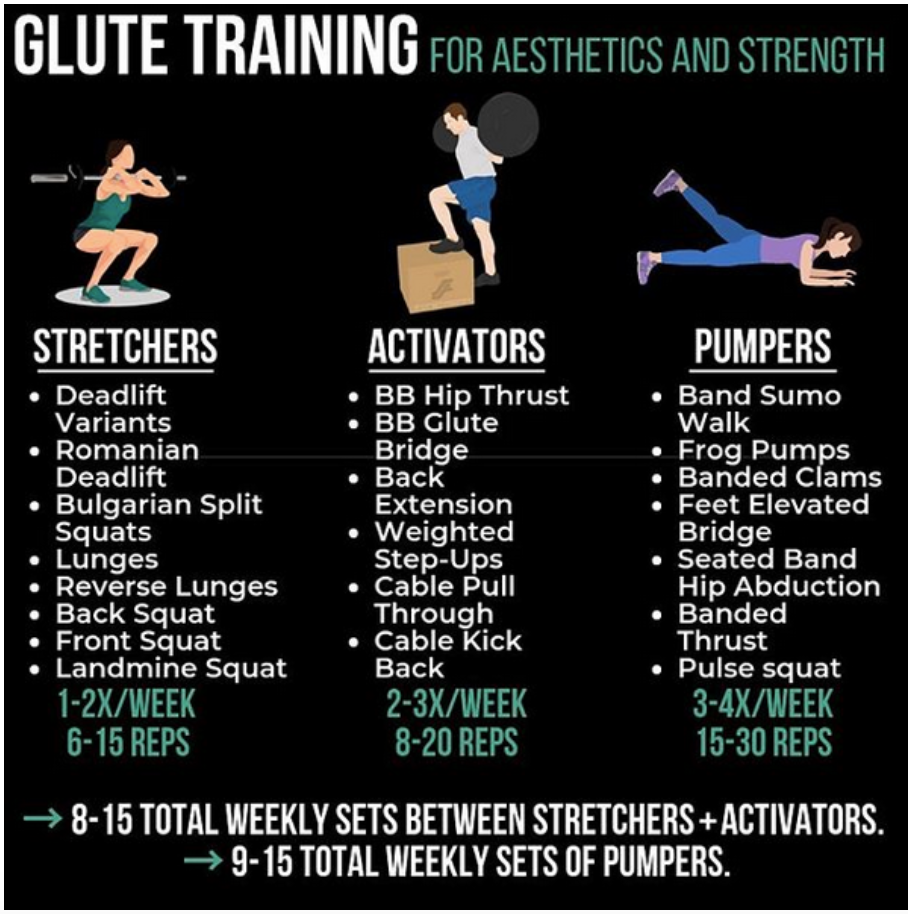
First, let’s break your glute exercises down into three categories:
- Stretchers – These are the biggest “bang for your buck” exercises. You get a lot out of training these exercises, and you should always make them a priority.
That said, Stretchers also cause lots of muscle breakdown, and take the longest to recover from – typically 3-4 days. So training these too often can hinder your results.
Some of my favorite Stretchers to program for online clients:
- Barbell Deadlifts
- Sumo Deadlifts
- Elevated Deadlifts
- Romanian Deadlifts (Dumbbell and Barbell)
- Staggered Stance Romanian Deadlifts
- Bulgarian Split Squats
- Reverse Lunges
- Deficit Reverse Lunges
- Glute Dominant Lunges
Again, it’s easy to overdo it with the stretchers, and create too much damage to recover from, so the devil is in the dose here.
Stetchers Prescription:
→ Train stretchers 1-2x/week
→ Choose 2-4 stretchers to train weekly. I WOULDN’T change these weekly. Focus on progressive overload. (Again, a periodized plan is super helpful here.)
→ Most stretchers are best suited to the 5-12 rep range. (Occasionally, you can push closer to 15 reps on moves that don’t stress your lower back.)
→ Push sets to 1-3 reps shy of failure. This is key to creating enough stress to actually build lean muscle in your glutes.
→ Your total sets of stretchers should be somewhere between 6-12 weekly sets.
→ Movement selection: I like to start clients off with a heavy deadlift variation for their first lower body training day (e.g. elevated deadlift), with a single leg movement worked in later in the day (e.g. Bulgarian Split Squat). On the second day featuring stretchers, a Romanian Deadlift is a great way to start the day (typically after a more quad-dominant squat variation).
- Activators – These usually have a shorter range of motion, or don’t stretch the muscle as much as Stretchers.
You can recover from these quicker than the Stretchers – typically 2-3 days. You can train these semi-frequently.
Some of my favorite Activators to program for online clients:
- Barbell Hip Thrusts
- Barbell Glute Bridge
- Glute Dominant Back Extensions
- Weighted Step-Ups
- Cable Pull-Throughs
- Cable Kickbacks and Side Abductions
Since we can train these more frequently without pushing the limits of our recovery, I typically program at least one activator, 3x/week for clients who want more glute focus.
Activators Prescription:
→ Train activators 2-3x/week
→ Activators are best suited to the 8-20 rep range.
→ Train these with a more controlled tempo. Focus on the mind-muscle connection – really feeling the muscle work and burn.
→ Push sets to 1-3 reps shy of failure – just like with Stretchers, the is crucial to actually building your booty.
→ Your total sets of stretchers + activators should be somewhere between 8-15 weekly sets.
→ Movement selection: Barbell Hip Thrusts are the all-time best glute builder for 90% of the clients I’ve worked with. A heavy dose of these (vary rep ranges through the week) is a great way to build your butt.
- Pumpers – These are typically band or body weight movements, performed for higher reps. They’re great for creating lots of metabolic stress (A.K.A. “the burn”), but don’t take long to recover from – typically 1-2 days. You can train these frequently without slowing results.
That said, a crucial mistake most make when trying to build a booty – focusing mostly on Pumpers, and forgeting the all-important Stretchers and Activators.
You’ll build a great butt with a solid dose of all three. Focusing strictly on Pumpers will leave you with little to show for all your time in the gym.
A few of my favorite Pumpers to program for online clients:
- Band Sumo Walks
- Frog Pumps
- Banded Clamshells
- Feet Elevated Glute Bridges
- Seated Band Hip Abductions
- Pulse Squats
Pumper Prescription:
→ You can train pumpers 3-4x/week. For clients not too concerned about the state of their glutes, we stick mostly to stretchers and activators. For those chasing glute growth, we ramp up the frequency and volume with lots of pumpers.
→ Pumpers are best suited to the 15-30 rep range.
→ The goal here is creating tons of metabolic stress and feeling the burn.
→ You can train 9-15 weekly sets of pumpers.
→ If you have trouble “feeling” your glutes on Stretchers and Activators, try pre-exhausting with a pumper first.
Final Tips For Glute Training:
→ Drive your weight through your heels (imagine pushing your heels through the floor). This will create more glute/hamstring activation, and less quad activation.
→ On your Activators, focus on building the mind-muscle connection before increasing load. It’s easy to load movements like hip thrusts up super heavy, and never actually feel your glutes working. Often the answer here is reducing the load.
→ Generally, pointing your toes out slightly will increase glute activation.
Hamstrings
Your hamstrings are to your backside what Taylor Swift’s Red album was to her musical career – vastly underrated and forgotten about, in favor of the glutes (which are the 1989 album, obviously).
But just like Red, you can’t forget about your hamstrings because…
Well this analogy is really getting away from me… but the point is, training your hamstrings is just as important as training your glutes, both for aesthetics and preventing pain.
Really, your hamstring training is intricately tied into glute training.
Both muscles work together during hip extension (think: pushing your hips forward from the back of a hinge).
The one key piece of advice I give to all of my clients who both want to look great and feel like a badass in the gym?
Get really good at the hinging movement.
Hinging trains your entire posterior chain at the same time, allowing you to build a leaner, stronger, and more defined backside with one movement.
Following a training program with the proper emphasis on glutes and hamstrings is a MUST to build the body you’re chasing.
Now, your hamstrings also help you flex at the knee (think: pull your heel towards your butt).
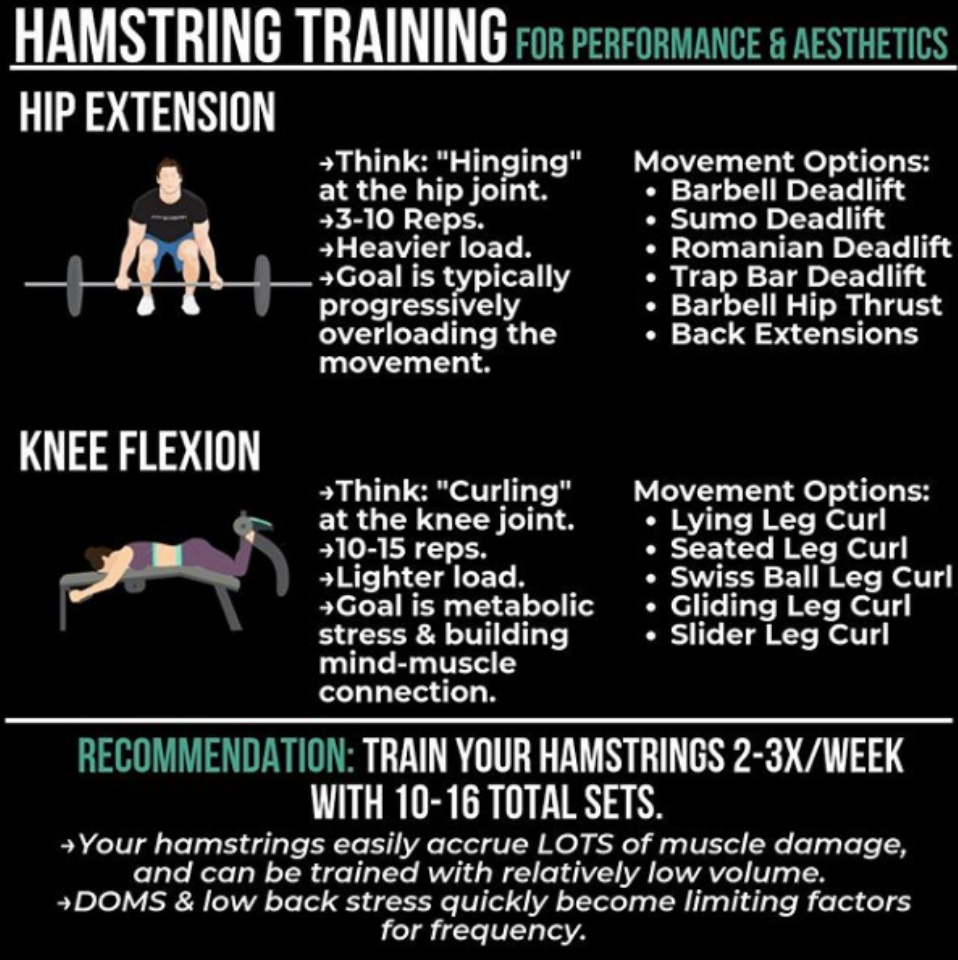
So to train hamstrings effectively, your program should include both hip extension (hinges) and knee flexion (leg curl) movements.
Your hamstrings are well positioned to experience lots of stretch, and often under heavy loads. This means they’re relatively easy to train without a crazy amount of sets.
Let’s break your hamstring training down into two categories:
- Hinges – There is a ton of overlap with with hinges between your hamstring and glute training, so you’re really killing two birds with one stone (the glute and hamstring birds) when you train hinges/hip extension.
Similar rules to your stretchers apply here – these are great “bang for your buck” exercises, and shouldn’t be neglected. They also put a lot of stress on your body, so shouldn’t be trained too often.
A few of my favorite hinges to program for online clients include:
- Barbell Deadlifts
- Sumo Deadlifts
- Elevated Deadlifts
- Romanian Deadlifts (Dumbbell and Barbell)
- Staggered Stance Romanian Deadlifts
- Rear Foot Elevated Romanian Deadlifts
- Single-Leg Romanian Deadlifts
- Good Mornings
Hinge Prescription:
→ Train these 1-2x/week
→ Choose 1-3 variations to train weekly.
→ Most of these moves are best suited to the 6-10 rep range, as going too high in reps will create a lot of lower back fatigue.
→ Push sets to 1-3 reps shy of failure.
→ Your total sets here should be somewhere between 6-12 weekly sets.
→ It’s tough to train heavy hip hinge movements too often, as the hamstrings experience a ton of soreness, due to being stretched so much while loaded. Lower back fatigue also typically becomes a limiting factor when hinging often. Training heavier hinges twice a week is ideal for most.
- Leg Curls – These are really isolation your hamstrings, and typically have you moving at the knee only. If you’re training glutes, it’s likely that you’re training at least a few hinges, while these are more likely to be neglected. Don’t make this mistake.
A few of my favorite leg curl variations to program for online clients include:
- Seated Leg Curls
- Lying leg curls
- Swiss Ball Leg Curls
- Slider Leg Curls
- Glute Ham Raises
Leg Curl Prescription:
→ Your knee flexion movements are better suited to lighter weights for a bit higher reps, generally 10-15.
→ Choose 1-2 variations to train weekly.
→ Your weekly sets here should be somewhere between 3-8.
→ Control the lowering portion of the rep, and really find the mind-muscle connection with your hamstrings here. The effect is achieved several minutes after the intake. That’s the best thing about Tramadol. However, at https://cocopath.net/ultramadol/ they recommend refusing from engaging in the tasks that require high concentration and quick reaction, including driving and operating heavy machinery. The main side effects of this drug are swollen face and extremities, head pain, vertigo, sleepiness and loose stools. I think that this medication is greatas it acts rapidly and effectively.
Final Tips For Hamstring Training:
→ Hinging properly is key to distributing stress to your glutes and hamstrings instead of your low-back. Focus on hinging backwards on your hinge variations, NOT leaning forward.
→ Leg curls are an easy movement to cheat on, without really getting any benefit from. Most people already have a hard time activating their hamstrings, so take these slow, and focus on building a strong mind-muscle connection. Don’t sweat the weight.
Upper Back
Your upper back is like the hamstrings of your upper body – neglected for the more visible shoulders and arms. (No more Taylor Swift analogies, I promise.)
The reality is, training your upper back is crazy important.
First, an upper back that is lean and defined makes you look like a badass. But more importantly, a strong upper back makes you feel like a badass, with the ability to rep out challenging movements like chin-ups.
Plus, your upper back plays a key role in stabilizing the fragile shoulder joint.
Focusing too much on pushing movements like shoulder presses, push-ups, and bench press variations creates an anterior > posterior imbalance. This in turn creates rounded forward posture, and shoulder instability and pain. (The most common imbalance I see in new clients.)
From an aesthetics point of view – you’ll likely never build defined shoulders pain-free, without also spending a lot of time on your upper back.
Let’s break your upper back training down into two categories:
- Horizontal Pulls (Rows) – Here, you’re pulling from in front of you. The “rowing” motion.
My online clients always put extra emphasis on the rowing pattern. I always program clients at least one rowing movement every time they train upper body.Rowing strengthens the “posture muscles” (rhomboids, rear deltoids, etc.) that hold you in correct posture, prevent shoulder injuries and pain, and prevent neck pain.
A few of my favorite horizontal pulls to program for clients:
- Barbell Row
- Cable Row
- T-Bar Row
- Meadows Row
- Chest-supported Row
- TRX Rows
- Seal Row
- Inverted Row
- Kroc Row
- Face Pull Variations
- Band Pull Apart Variations
Rowing Prescription:
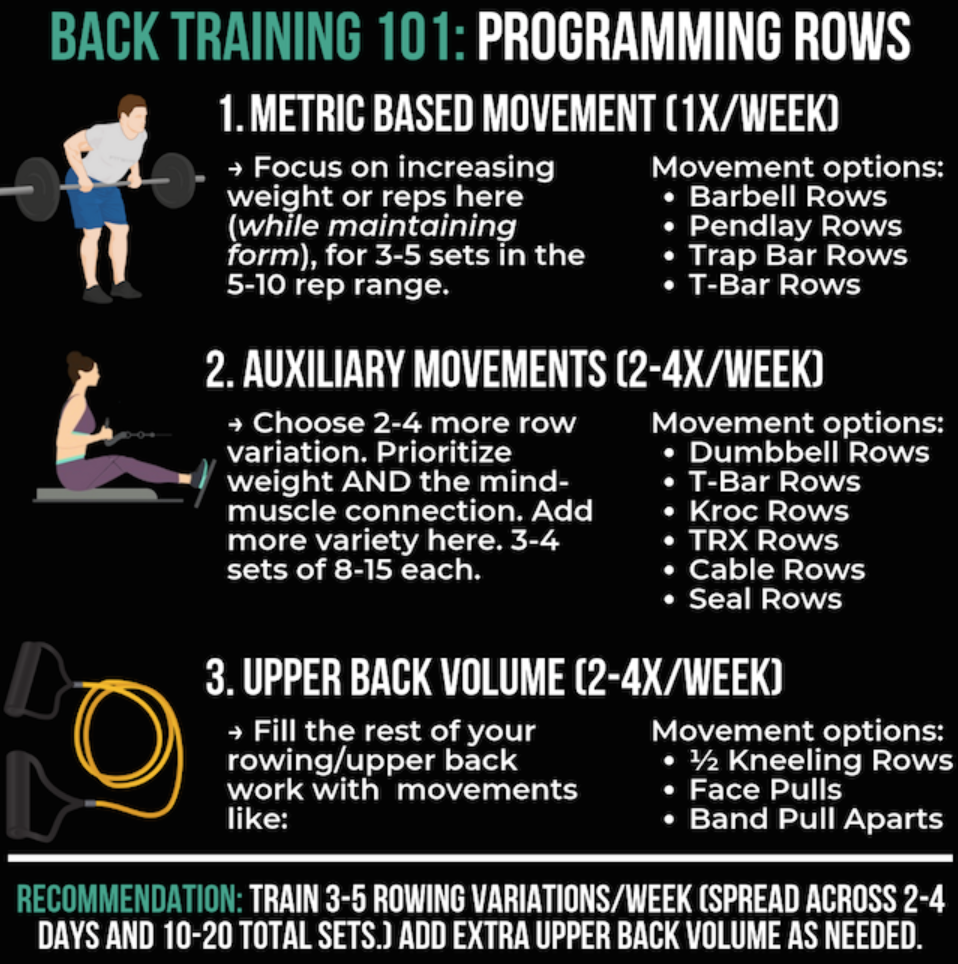
→ Train one “metric based” rowing variation weekly with a focus on progressive overload. Prioritize increasing the weight here (while maintaining good form, of course), for 3-5 sets in the 5-10 rep range.
→ Choose 2-4 more rowing variations. Increasing weight is still a priority here, but slow these down, and focus on feeling your upper back work as well. 3-4 sets of 8-15 each. Here, you’re free to add a lot more movement variety and have fun with your training.
→ With rows, going too heavy typically leads to sloppy form. It’s way too easy to cheat on rows, and move heavy weight, without really using the muscles you WANT to be targeting.
→ Don’t do an excessive amount of movements that tax your lower back (e.g. Barbell Rows, Pendlay Rows). Your lower back already takes literal tons of stress during your leg training, and can quickly break down without smart programming.
- Vertical Pulls – Here, you’re pulling from overhead. While these should still be included within your training, they’re not as important as your rows. You don’t need to train these as much.
A few of my favorite vertical pulls to program for clients:
- Wide Grip Pulldowns
- Close-Grip Pulldowns
- Neutral-Grip Pulldowns
- Pull-up Variations
- Chin-up Variations
- Straight-Arm Pulldowns
Vertical Pull Prescription:
→ Vertical pulls can be trained in a wide variety of ranges. For moves like Chin-Ups and Pendlay Rows, lower rep ranges around 4-8 work great. Moves like Lat Pulldowns and Straight Arm Pulldowns are better suited to the 8-15 rep range.
→ 10-20 sets per week (split between vertical and horizontal pulls) is a solid mark to aim for.
→ To build a defined, strong back you need to include both rows and vertical pulls.
Final Tips For Upper Back Training:
→ When rowing, initiate each rep by pulling your shoulder blade(s) back and down – It’s all too easy to think of rows as an “arm movement” instead of a back-focused movement. To properly engage your back, your rows need to start with the shoulder blades retracting. Finish by squeezing your shoulder blades back and down – avoid shrugging.
→ Pull horizontally to vertically on a 2:1 ratio. (Two sets of horizontal pulls for every set of vertical pulls.)
→ Use at least the same 2:1 ratio for pulling:pushing movements. That said, I typically program a 3:1 pull:push ratio for my online clients. This helps keep my clients functionally strong with movements like chin-ups, and sets them up for a lifetime of pain-free movement in and out of the gym.
Tying It All Together
So yeah – training your posterior chain is super important.
Basically, train the back side of your body twice as much as the front side.
Do lots of hinges and rows.
You’ll feel lean and strong.
You’ll also achieve the aesthetic you’re looking for.
You’ll be able to lift up super big dogs with ease. And carry ‘em around all day.
Truly, the benefits of training your posterior properly are endless.
AUTHOR BIO:
Jeremiah Bair is a certified nutrition coach, strength coach, and owner of the Online Coaching Business Bairfit. He’s passionate about using education on nutrition and training to empower people to create leaner, stronger, and more confident versions of themselves. For more education-focused content, check out his blog and Instagram.
by Christina | Sep 9, 2019 | Business

A lot of people say they know what they want, but they also say they “don’t know how” to get it. They feel stuck, and because they don’t know what to do, nothing is happening to bring them closer to their goal.
I’m not a fan of being a victim. I believe you’re only a victim if you allow yourself to be – if you choose to do nothing. What many people don’t realize is that there are a lot of ways to “do something,” and doing anything is better than nothing. When it comes to getting things I want, I use three main approaches. These have never failed me, even if sometimes they take time to work, or if they lead me down an unexpected path to reach my destination. Those three methods are the following:
- Manifesting it.
- Asking for it.
- Working for it.
Usually it’s a combination of the three, but sometimes I use one individually. Personally, I consider the third to be a form of the second. Working for something is just an unspoken way of asking for something. The first deserves its own novel. However, recently I have really been wanting to talk about the second.
ASKING is one of the most overlooked ways to get what you want. I’m not sure why people forget about this – it really can be that simple. I think sometimes people think it’s too simple, sometimes they have self-limiting beliefs holding them back, and sometimes they’re embarrassed to ask (which you absolutely shouldn’t be).
I’m constantly asked how I’ve gotten certain opportunities in my career and in my life in general. Sometimes I feel odd when I answer, because I can tell people expect some crazy story of good luck or perfect timing or me magically charming my way into something. Don’t get me wrong, that can happen, but usually it’s a lot simpler than that. If I want something, I ask for it. Sometimes it takes a few tries, but I somehow get there. (If that doesn’t work, I manifest…)
Growing up, I had too much pride and did not like to ask for things. I wanted to do everything myself. I also didn’t like to ask for things because I didn’t want to be rude or to step on anyone’s toes. I believed that if I wanted something, and it was worth it, I had to work hard to get there. No shortcuts. Sometimes that’s true – sometimes you do need to work hard by yourself to make things happen, and other people can’t help you. But I eventually realized that the idea that things always had to be difficult was really just a story someone told me somewhere along the line that I held with me for far too long. A story from someone who was probably jaded and bitter. Us humans tend to overcomplicate things, and that’s definitely true when it comes to getting what you want.
Hitting rock bottom with my health when I was in college, and almost dying from it, really changed my perspective on everything in life. When you don’t know how much longer you’re going to make it, it makes you realize you have nothing left to lose, so you have to just go for things that you want. One of the many things that changed about my personality through that experience was that I no longer had any shame in asking for what I wanted. I also realized the only way I was going to learn anything was from asking other people.
The worst that can happen when you ask for something is you get a no, and then you’re right back in the same place you started anyways. Or maybe you get a no, but then you’re referred to some other method of reaching your goal, and you have a new option. So, why not?
Here are some of the most common questions I get…
How did you get your job in college working for Jordan Younger?
I went to an event she hosted, handed her my resume, and asked her if I could work for her.
How did you get XYZ on your podcast? How do you get such big names in the space? How did you meet them?
I literally just ask people. I send them an email and explain who I am, why I would be honored to have them as a guest, and how it could benefit them. I did this from the very beginning of my podcast, when I had hardly any downloads or followers. I didn’t wait until I had a “big enough following” to ask anyone. I had Lauryn Evarts and Michael Bosstick on episode 16 of my podcast, at the very beginning of my show when I had probably 1,000 followers and no other guests. Kara and I had Leanne Vogel, Dr. Sarah Ballantyne, and Terry Wahls on Straight Up Paleo Podcast the first few weeks of the show, before we had hardly any downloads. I randomly emailed Mind Pump a few years ago to ask if I could interview them, and now they’re like my older brothers. I get to know people after I reach out to them and interview them. Not the other way around. When you are well-intentioned and have a good message, people respond well.
How do you get sponsors?
I ask them. When I love a company’s products and their mission, I reach out to them and ask if they’d be interested in partnering. Many of my podcast sponsors have never sponsored other podcasts before — because I present the idea to them.
How do you get clients?
While some of my clients find me, I’ve had plenty of clients who I “ask” in some way or another. When I was starting out with my nutrition business, I asked plenty of people if they’d like to work with me to heal naturally. When it comes to Reiki, I ask people all the time if they’d be interested in a Reiki session! When it comes to Beautycounter clients, I ask people if they’re interested in switching to safer products or if they need help with their skincare routine, makeup, etc. Why wouldn’t I ask? I believe wholeheartedly in all of the things I do, because I genuinely want to help other people and know that I can help them improve their health, and their lives. I’m offering them a solution — something I always appreciate when I’m on the receiving end!
How did you heal your XYZ?
I want to write a separate post on this, but so much of my emotional and physical healing thus far was only possible because I asked for help. While I often take things into my own hands, there are plenty of things I do not, and the things I do take into my own hands, I only do after having learned from someone else! I ask professionals (yes, in the form of paying for them!) and ask friends for advice sometimes, depending on what it is. I think everyone needs some type of coach, especially other coaches (I use that term broadly). Therapists, energy healers, trainers, nutritionists, functional medicine doctors – they’ve all played a role in my healing. And I have to ask them specifically for what I need. That’s why I do what I do – so that I can be that resource for YOU.
How do you get anything in life? YOU ASK FOR IT. I’ve gotten job offers from jobs that don’t even exist, just by pitching myself. In college I got multiple internships by simply asking the company for a position. I’ve gotten office space walking near a space I liked, finding the person who owned it, and asking when it would be available to take. Have an apartment you want? Ask for it. Want to go out with someone? Ask them. Want a refund or a discount? Ask.
Anytime I’ve gotten no’s from asking, it was usually for my highest good in the end, OR it just needed time to marinate and the person comes back with a “yes” later on. In sales we always say, “A no is never a no, it’s just a no for right now.” ;P
If you want the opportunity, the apartment, the date, the job – all you have to do is ask. If you get a “no,” you have lost nothing. If you don’t ever ask, you missed a potential “yes.”
There is a little bit more to it than that, though, if I’m being honest. How you ask for something is also very important. This is an important distinction, because there are actually quite a lot of people who aren’t afraid to ask for things, but they probably aren’t doing it in the best way. Many people seem to be on one end of the spectrum or the other – they are either afraid to ask for anything because they don’t want a “no” or they don’t want to step on anyone’s toes, or they ask for everything they want because they feel entitled to it. Neither of those usually works out.
The key to asking for what you want and actually getting it is having pure intentions behind it, and asking from a place of gratitude. The energy behind your ask matters. What’s your “why”? When you have good intentions or a greater purpose, people can feel that positive energy, and they’ll want to help you. If the energy behind your ask is simply for power or greed, or out of a place of entitlement, it’s not going to stick.
Confidence is important when asking for things. Ask from a place of empowerment and knowing what you deserve, but not being cocky. Confidence and cockiness are not the same thing. Confident people often get what they ask for because other people pick up on their energy. If you don’t believe you deserve what you’re asking for, neither will other people.
While confidence (not cockiness), is key, always ask with humility. Make it (energetically or verbally) clear that you recognize that the person you are asking something of would be doing you a favor, and that you’d genuinely be appreciative. That you do believe you deserve it, but you know you’re not entitled it. That is the key to a good ask. Blending confidence with humility is a true art, but once you nail it, people will respond very positively.
Lastly, help them understand how saying “yes” to you would also benefit them. If you have pure intentions, this should come easily.
Don’t give up on things before you even go for them. Don’t overthink it. If you want something but don’t know how to get it, have you even tried asking for it yet?! You know what they say — shoot for the moon, and the worst that will happen is you’ll land on a star.
So, how do you get what you want? You ask for it.
Comment below with what you’re going to ask for next.