
by Christina | Oct 23, 2018 | Member Exclusives, Wellness

The vagus nerve is one of my favorite topics to discuss, because understanding the vagus nerve allows us to better understand the intricacies of how everything in the body is intertwined.
___________________________
This complete post is only available for The Channel Collective members. Click here to become a member, or click here to log in!

by Christina | Oct 14, 2018 | Wellness

When my sister was on her honeymoon a few months ago, she asked me to write a blog post about the top essential oils to bring on travel so that she’d be ready the next time she went away on a trip. A lot of unexpected ailments can come up while traveling – bug bites, fatigue, bloating, stomach pain, bruises… Thankfully, essential oils can help you with all of that, and more!
I have been traveling a lot the past few months, especially this month. I just came back from San Mateo, Tahoe, and Canada, and I’m headed off to San Diego, Indiana, and Chicago in the next week! I figured it’s the perfect time to write this blog post, because I can just pour out my essential oils bag and let you know what’s inside.
I use my doTERRA essential oils as my natural “medicine cabinet” in everyday life, and I always bring them with me when I travel. Traveling makes everyone feel a little “off,” and using your essential oils can help you still feel your best despite a lack of routine. Essential oils can be used to help with sleep, headaches, digestive discomfort, body pain, sickness, bug bites, and any other symptoms that might come up while you’re visiting a new place. You don’t want to be caught unprepared! I use doTERRA essential oils because they are the highest quality on the market and the only ones I feel comfortable ingesting and applying to my skin. They’re 100% pure, unlike the oils you’ll find at the store, and that means they will actually work. To learn more about why I use doTERRA and how to get started, you can check out this post.

I’ve compiled a list of the essential oils I personally bring with me when I travel, as well as some “honorable mentions” that I bring most of the time, but not always if I’m low on space. (Let’s be honest, though, I usually always make space.) I use these on myself, but I also like to have them on hand to help out anyone around me who’s complaining about their digestion, headaches, or poor sleep while traveling. Hopefully this list helps you prioritize what essential oils you’d like to bring with you the next time you go on a trip! Don’t be caught without your oils. 😛
- Lemon – Lemon is one of my most-used oils in general, and I always bring it with me on travel because I like to start my day off with warm water and lemon. Lemon is incredibly detoxifying, and beginning the morning with warm lemon water helps kickstart my digestion. Traveling in general tends to throw off people’s digestion, so this is really helpful. I begin every morning with warm water, ACV, and lemon at home, so bringing the lemon oil with me allows me to maintain that part of my routine. Lemon is also great for cleaning, so if I’m traveling and need to remove some type of residue, lemon comes in handy. For example, it helps get stickers off of containers, and recently I used it to clean my hair curler because it somehow got sticky residue on it while it was in my luggage. Lemon is also a mood-booster, which is always nice to have on hand in case I’m tired and grumpy one day while traveling!
- Peppermint – Peppermint is another one of my most-used oils and a non-negotiable for traveling. First of all, it’s great for any type of digestive discomfort. You can apply it topically to your stomach, or you can ingest it internally to help calm your stomach (which is really helpful when eating questionable food on vacation). I also use this instead of bringing peppermint tea bags with me – you just need a drop or two of peppermint essential oil in hot water to replace peppermint tea! This also helps if you have bad breath, and we all know that most restaurants like to load up on garlic and onion! Peppermint is also great for headaches or migraines. Just apply it to your temples and the back of your neck to naturally get rid of a headache. Similarly, I use it anytime I have any type of pain, ache, scrape, or bug bite. Peppermint soothes the area and cools it down. If you tweak your ankle, pull a hamstring, are sore from walking, or get some bug bites, apply peppermint oil every few hours to provide relief to the area. It’s also great for opening up your airways. I like to apply this under my nose or to my chest if I feel congested. I also like to use Peppermint because it helps with focus. If I’m on travel and need to bust out a few hours of productive work, I put peppermint on my pulse points or just breathe it in, because the scent promotes concentration. It’s great if you need to study or read something in a noisy area.
- Lavender – Another non-negotiable! Lavender is my go-to for restful sleep. Sometimes it’s difficult to fall (and stay) asleep when traveling because you’re not in your own bed, but lavender oil puts me out like a light. I like to put a drop on my pillow, and I also apply it to the bottoms of my feet before bed to help me stay asleep all night long. Lavender is also great for promoting relaxation in general. I like to use this in the evening to help me calm down, especially when I’m adjusting to a new time zone. Lavender is also helpful for skin irritations and body pain. You can apply this to bruises, cuts, burns, sore muscles, and even zits to calm inflammation. If I’m traveling and have any type of skin irritation, bruise, or pain on my body, I apply lavender and peppermint onto the area every few hours to help it go away much faster.
- DigestZen – I recommend everyone carries this with them at all times! DigestZen is my go-to anytime I have any type of digestive discomfort, which is more likely when traveling and eating different foods than normal. You never really know what restaurants are putting in their food (again, the garlic and onions…). DigestZen helps with bloating, constipation, diarrhea, nausea, cramps, or any other type of digestive issue. You can apply it topically all over your stomach, or ingest it internally by adding a few drops to warm water or taking it in a capsule. Some people find it works better for them internally OR topically, so find what works for you! Personally, anytime my stomach hurts or isn’t feeling that great, I apply this all over my stomach and take 4 drops in a veggie cap. Works like a charm.
- On Guard – Whenever I need immune support, I turn to On Guard. Think antibacterial and antiviral when you think of this blend! I like to add 4 drops to a veggie cap (along with Oregano, if I have it) and ingest it any time I feel like I need an immune boost. I use this if I am already getting a little sick, or if I feel like I’m about to get sick. I also like to have this on hand in case I need to clean something, because On Guard is amazing as an all-purpose surface cleaner. In a pinch, I can just mix it with some water and clean any surface (this comes up in hotels and Airbnbs sometimes!). I’ll also apply this to my hands as a natural hand cleaner / antibacterial if I feel like I’ve been touching a lot of germs. I also like to put On Guard on any cuts, scrapes, or other open wounds to clean them out and help them heal faster. Sometimes I also apply this on top of bug bites or bruises along with my Peppermint and Lavender. On Guard also smells AMAZING, so I like to breathe it in or diffuse it in a travel diffuser!
- Melaleuca (Tea Tree Oil) – Tea Tree oil is great for purifying and supporting immune function. Anytime something needs an extra strong cleaning, I use tea tree oil. If you get a cut or scrape, this can help clean it out so it doesn’t get infected. You can also add this into a veggie cap (I use 1-2 drops) anytime you’re feeling sick or need extra immune support. The real reason I love Melaleuca, though, is because it’s an incredible spot treatment for blemishes. If a zit pops up while I’m traveling, I always put Melaleuca on it and it dries right up. I always dilute it, though, because tea tree oil can be very strong and very drying.
- Oregano – Oregano is another very strong essential oil that has a lot of antioxidants and is great for supporting immune function. I bring this with me in case I get sick, which I find is more likely to happen when I travel. Anytime I feel a cold or flu coming on, I put 2-3 drops in a veggie capsule (usually with 4 drops of On Guard) and take that once every 4 hours or so. Oregano is your best weapon against any sickness. It has a VERY strong flavor (it burns), so I always use a veggie cap.
- Rose – I bring Rose with me because I use it as perfume. Rose and Jasmine are my favorite essential oils to use as perfume, but I consider Rose to be my signature scent. It’s emotionally uplifting and always puts me in a good mood. Rose is also great to apply to any skin imperfections, but I really bring it for its uplifting scent! I apply Rose to my chest and pulse points every day.
- Breathe – Breathe is our respiratory blend that helps anyone who is feeling congested or has allergies or asthma. If I’m feeling congested, I will apply this right under my nose or on my chest to help open up my airways. I also love diffusing this because it helps me focus. I don’t personally have allergies or asthma, but I like to always have this on hand in case I’m with someone who does because Breathe can work miracles for them. I’m so helpful, I know. 😉
- On Guard Hand Sanitizing Mist – This isn’t an oil, but I always bring this hand sanitizer with me when I’m traveling – especially on planes. The main ingredient is On Guard essential oil, which is our antibacterial / antiviral blend. This cleans your hands without drying out your skin, and it smells amazing!
- Veggie Caps – Again, not an oil, but this is how I ingest many of my oils! These are empty capsules that you can drop oils into so that you can take them like a pill. DIY supplements! These are really helpful when you need to take an oil that doesn’t taste good, like Oregano or Melaleuca.
- TerraZyme Digestive Enzymes – These are my favorite digestive enzymes, and I always like to have digestive enzymes with me when I travel since I’ll probably be eating different foods than I’m used to. Digestive enzymes can help prevent the bloating and stomach pain that you might usually encounter when you eat out at restaurants.

Oils I bring when I have extra room:
- Ginger – I also like to bring Ginger with me because it’s great for digestion and tastes delicious in warm water. It can help with bloating, nausea, cramps, constipation, and diarrhea. I’ll rub it on my stomach or take it in a veggie cap or in water if I’m having symptoms. I like to mix this with lemon essential oil in warm water in the morning to start my day off right – gotta get that digestion goin’!
- ClaryCalm – This is doTERRA’s women blend that helps to balance hormones and reduce any unwanted symptoms associated with menstruation, like cramps or moodiness. I apply this to my abdomen every single day to support my hormonal health .
- Frankincense – I like to have Frankincense on me when I can because it always helps ground me and calm me down anytime I have anxiety. It’s also great for any skin imperfections, like blemishes that might pop up. I like to take this internally everyday because it supports immune, nervous system, and digestive function – it’s like a daily supplement! Besides taking a drop a day under my tongue, I also like to apply it to my hands or to the bottom of my feet to help me feel more peaceful. When I’m traveling and out of my routine, this helps keep me grounded.
- TerraShield – This is doTERRA’s outdoor blend that will protect you against any insects. I use this more often in the summer, and I bring it anywhere I think I’ll be spending a lot of time outside, especially in the evening. For example, I always bring this to our family cabin where I typically get eaten alive by mosquitoes or swarmed by bees. You can apply this topically to your skin or diffuse it to keep bugs away.
- Blue Tansy – I usually bring this with me in my toiletries bag alongside my skincare because I like to apply it to my skin every night. It’s great for eliminating and preventing blemishes, and it’s very soothing to the skin in general.
I also wanted to include a quick list of ailments that might pop up while you’re on travel and which oils I recommend for each:
- Headache – apply peppermint to temples
- Upset stomach, bloating, nausea, constipation, etc. – DigestZen, Peppermint, Ginger – apply to stomach, ingest in veggie cap, or add a few drops to warm water
- Cramps – ClaryCalm, DigestZen, Peppermint, Ginger – apply to stomach or ingest through veggie cap or in water
- Bug bites – apply Peppermint, Lavender, and On Guard to the bite, use Terra Shield as prevention
- Sore / hurt muscles or body parts – apply Peppermint to affected area, can also add Lavender
- Cut / scrape – use Melaleuca and On Guard to Clean it, can also apply Lavender if it’s sore
- Zit – apply Melaleuca (dilute with water) to the zit, can also add Lavender, Frankincense, Blue Tansy, and/or On Guard to reduce the redness
- Cold / flu – 4 drops On Guard + 2 drops Oregano oil in a veggie cap, can also add 2 drops Melaleuca
- Insomnia – apply Lavender to the bottoms of your feet and your pulse points, add a few drops to your pillow, can also apply Frankincense
- Anxiety – Lavender, Frankincense
- Fatigue – Lemon, Peppermint – both are energizing and uplifting
As I’m sure you can tell, I’m more than prepared for anything that comes my way when I have my oils with me. There really is an oil for everything! I pack more oils with me than most people probably need to, but I’ve always been an over-packer. I absolutely CANNOT be without Peppermint, Lavender, and On Guard, though. They’re my lifeline!
What essential oils or other home remedies do you bring with you when you travel?!

by Christina | Oct 5, 2018 | Wellness

Oh, gluten – always the controversial subject. Many health professionals avoid the topic publicly because it can be so polarizing, and many people also feel like they don’t have enough information to formulate a strong opinion about it. Gluten also tends to be an emotionally-charged subject, and no one wants to alienate people from their audience. I definitely understand and respect that. I do have a strong opinion about gluten, though, and it’s no secret to anyone who works with me. If some groundbreaking information comes out in the future convincing me to change my mind, then I will happily admit I was wrong and revise this post with my updated opinion. I am 99% sure that will not happen, though, but never say never. When it comes to any topic, it’s okay to change your opinion if you learn new information – remember that.
However, as I write this, I’m confident in my stance on “the gluten issue.” It’s a topic I get asked about incredibly often, and after I discussed gluten in a recent Q&A podcast episode, I received a number of emails asking me to put the information in a blog post for easier reference.
I am a proponent of the paleo diet and lifestyle not just because it’s “paleo.” If there wasn’t a term for it, I would still eat and live my life the same way. I’m a fan of a paleo template because it naturally aligns with what I believe is generally best for people’s health. Grain-free, gluten-free, dairy-free, whole-foods — there are many terms for it. Going gluten-free has become a “fad,” but I think that everyone would benefit from a gluten-free diet… in the form of gluten-free whole foods, not gluten-free processed foods. That’s an important distinction.
Grains in general can cause issues for digestion and immunity. Phytates in grains can bind to minerals in the body and compromise their absorption. Meanwhile, lectins in grains can bind to insulin receptors, cause leptin resistance, and bind to the lining of the intestines. When the gut lining is damaged, this interferes with our ability to absorb nutrients necessary to have a healthy body and protect our bones, heart, brain, and other organs, and it also leads to inflammation throughout the system. That’s just grains. Gluten, specifically, is its own threat to our health.
What’s the deal with gluten? Before I give my spiel, remember that a number of experts have written entire books about this subject, and I encourage you to read those if you want as much in-depth, scientific information as possible. Grain Brain and Wheat Belly are two popular options, and Grain Brain was actually one of the first books I read before I went gluten-free. I learned much of what I’ll be explaining here from those books and other books I’ve read along the way.
Obviously, anyone who has Celiac disease or gluten sensitivity shouldn’t be consuming gluten. Celiac disease is an autoimmune disease where the immune system attacks the small intestine, which is triggered by the consumption of gluten. It can lead to digestive distress, bloating, constipation, diarrhea, fatigue, malnutrition, joint pain, depression, skin issues, and a number of other uncomfortable symptoms. Only about 1% of the population has been diagnosed with celiac disease, but it’s been estimated that 83% of celiac sufferers haven’t been diagnosed yet, or have been misdiagnosed.
Gluten should also be avoided for anyone who struggles with Hashimoto’s disease, an autoimmune disease where the immune system attacks the thyroid. This is due to something called molecular mimicry. Basically, gluten’s molecular structure is similar to that of the thyroid, so the immune system attacks the thyroid when gluten is ingested because it gets the two confused. I would also argue, however, that anyone with an autoimmune disease should completely avoid gluten. Most autoimmune diseases are rooted in leaky gut and inflammation, and gluten is a main cause of both.
Anyone who notices any negative symptoms after consuming gluten should of course leave it out of their diet. If you notice negative symptoms after consuming any food, then your body is better off without it, whether that be short-term or long-term. For example, if I consume gluten, I know that I personally can expect all or most of the following symptoms: bloating, nausea, dizziness, vomiting, extreme constipation or diarrhea, blurry vision, brain fog, stomach cramps, and rashes and blisters on my skin. Some of these symptoms, like bloating, irregular bowel movements, and brain fog, are symptoms that many people don’t even notice because they’ve lived with them their entire lives. It’s become their new normal. That was certainly my own experience. I didn’t recognize my extreme reactions until I had removed it from my diet for a few weeks, and then tried adding it back in.
What about people who don’t notice a reaction to gluten? Should they avoid it too? My personal opinion is a strong yes. Even if you can’t feel a reaction to gluten, that doesn’t mean it’s not harming your body or having an internal effect that you don’t notice.
Let’s take a step back and talk more about what gluten is. Gluten is a protein found in many grains that usually acts as an adhesive substance in foods and other products. Wheat is probably the most well-known source of gluten, but gluten is also found in foods like rye, barley, and spelt. You’ll find gluten in anything “bread-y” and most things that are “sticky.” Gluten is actually Latin for “glue.” Gluten is in pizza, baked goods, crackers, sauces, spreads, dressings, and many processed foods. Since it helps thicken things, gluten is also found in many personal care products, like hair conditioners, mascaras, and toothpaste.
Gluten is made up of two main groups of proteins, the glutenins and gliadins. People can react to either of these, to both of them, or to the smaller units within them. The main reason why gluten is a threat to health is because of its effects on the gut and brain. Gluten is toxic to intestinal cells, contributes to leaky gut, and produces inflammation throughout the body.
Leaky gut, or intestinal permeability, is at the root of most health issues many people encounter today. Gluten does no favors to the gut – it prevents cell reproduction, increases cellular oxidation products, changes cells’ membrane structure, and even kills intestinal cells. Gluten is a toxic lectin that has a structure incompatible with our bodies’ own digestive enzymes, which means it not only resists digestion but can also inhibit the function of certain digestive enzymes in general. This is why I think removing gluten from the diet is non-negotiable for anyone with gut issues.
Gluten impairs digestion, and then it creates an immune response as the body works to clear gluten from the system. All of this contributes to intestinal permeability. Over 70% of our immune cells are in the digestive tract, which is why leaky gut causes so much immune reactivity and can lead to problems like mood disorders, memory issues, chronic joint pain, weight issues, hormonal imbalances, digestive issues, and more. And yes, everyone experiences a breakdown of their gut lining, on some level, when exposed to gluten.
Whether you realize it or not, consuming gluten activates your immune system. Wheat, specifically, contains amylase trypsin inhibitors that can create an inflammatory response in the gut by stimulating immune cells, which is actually a problem separate from gluten sensitivity. However, inflammation occurs in the guts of non-celiac patients even without the formation of gliadin antibodies, which reveals that gluten can affect everyone whether or not they see antibody reactions on tests.
How does the whole “leaky gut” thing work? The consumption of gluten triggers the release of zonulin, a protein that opens the tight junctions between gut cells. To be more specific, it’s the gliadin in gluten that stimulates zonulin. When those tight junctions are open, this allows foreign molecules like proteins and bacteria to cross the gut barrier and enter the bloodstream. (The gut lining is “leaky.”) When molecules meant to stay in the gut pass into the bloodstream, the body recognizes these molecules as foreign invaders and mounts an immune response, leading to inflammation that can manifest in many ways.
Lipopolysaccharides are one type of toxin that can enter the bloodstream and cause a strong immune reaction in the body, leading to memory problems, depression, flu-like symptoms, chronic disease, and more. Going back to autoimmunity, some proteins might enter the bloodstream and look suspiciously like the body’s own tissue, causing the immune system to attack its own organs. This can lead to autoimmune diseases like lupus, rheumatoid arthritis, and Hashimoto’s. Foreign molecules can bind with receptors on your liver and fat cells, causing inflammation and cellular metabolism changes that lead to weight gain. Gallbladder problems, as well, have been linked directly to gluten intake.
When foreign molecules and toxins pass into the bloodstream, they might also cross the blood-brain barrier and enter the brain, mounting an inflammatory response there. There is a lectin in wheat called wheat germ agglutinin that can attach itself to myelin sheaths in the brain and block the growth factor that allows the brain to repair itself. This compromises the brain over time, without showing any immune reactivity at all. This is one way in which wheat harms the body without being “detected.” A significant number of neurological diseases have been linked to gluten exposure, and many individuals suffering from neurological issues show gliadin-reactive antibodies. Molecular mimicry can lead to an attack on the nervous system, even without any GI symptoms.
Gluten consumption is especially harmful in America because most gluten-containing grains are sprayed with glyphosate. Wheat, in particular, is one of the biggest offenders. Wheat is treated heavily with Roundup, which kills the good bacteria in our guts, prevents the growth of more good bacteria, depletes our bodies of nutrients, causes high levels of inflammation, and can lead to cancer. It changes our microbiome in a very negative way. Today’s wheat has more gluten and less vitamins and minerals than any grains people were eating upon the advent of agriculture. Wheat also contains opioids that make it quite literally addictive. As previously mentioned, wheat germ agglutinin, the inflammatory immune-disrupting protein in wheat, creates inflammation in gut cells and harms the immune barrier in the gut, leading to intestinal permeability. This is an issue separate from gluten, and that PLUS the effects of gluten itself can be a recipe for disaster.
I do think that a big reason why people have such a hard time removing gluten from their diets is because gluten-containing foods can be incredibly addictive. No one wants to eliminate foods they’re addicted to, whether or not they’re conscious of that addiction. Gliadin can stimulate opiate receptors in the brain, which is why they’ve been called “gliadorphins.” This can cause a number of psychiatric effects as well as some level of addiction, and it’s why people who eat a lot of gluten often go through a period of withdrawal when they stop. When you consider the fact that most gluten-containing foods also contain other addictive ingredients, like refined sugar, it makes sense why it’s so difficult for people to give them up.
Testing for celiac disease and “gluten sensitivity” is far from perfect and barely scratches the surface, which is why I don’t think people should wait for a test to tell them that they shouldn’t eat gluten. It can take people years to get an official diagnosis of celiac disease even if they are actively searching for that diagnosis. False negatives are common, and tests in general aren’t that accurate or comprehensive. Most doctors doing a celiac panel only test for 3 things – endometrial antibodies, alpha gliadin, and tissue transglutaminase. Gluten-containing grains can produce over 20,0000 proteins…. that’s a lot of proteins we aren’t checking. Plus, as previously mentioned, gluten does affect everyone whether or not they have celiac or gluten sensitivity, and it could be affecting you in a way that can’t be picked up on a test yet.
An interesting sidenote – I’ve heard some people argue that Celiac disease is actually an advanced human adaptation, and the negative symptoms felt from consuming gluten (although some people with Celiac don’t even have noticeable symptoms) are a beneficial response to a toxic substance we aren’t meant to consume. In other words, those negative symptoms prevent people from eating gluten because avoiding gluten is the way we were meant to adapt in order to survive longer, and the people who don’t have this adaptation aren’t meant to survive as long. Survival of the fittest… Darwin… you get the idea. Again, that’s not my idea, but it is an interesting perspective. Celiac incidence has increased by 3-4 times in the last 50 years, and gluten sensitivity is rising quite rapidly as well… food for thought.
There isn’t a clear-cut answer regarding how long gluten stays in the system, and it depends on the individual. For some it could be a few weeks, for others 6 months, and for others longer. Either way, when you consume gluten, it’s not something that will leave your system “quickly,” by my standards. I point this out to explain why sometimes people need to wait a long time to really get their bodies to a “clean slate” before being able to add gluten back in and notice any symptoms. Also, this helps explain why some people show stronger reactions than others, and why some people might feel fine if they have gluten every once in awhile while others need to eliminate it completely.
I want to reiterate that inflammation is at the root of every chronic illness, and gluten leads to inflammation. The consumption of gluten has been linked to a number of debilitating health issues like IBD, osteoporosis, autism, schizophrenia, depression, cancer, heart disease, fibromyalgia, and more. Remember that reactions to gluten can manifest in a wide variety of ways other than the typical bloating, constipation, diarrhea, and other digestive symptoms most people think of. Gluten consumption can cause allergies, acne, psoriasis, eczema, insulin resistance, blood sugar issues, hormonal imbalances, anxiety, joint pain, and more.
Epidemiological evidence suggests that almost everyone who eats wheat dies earlier than those who don’t. There are a number of longterm, chronic diseases that typically “pop up” later on in people’s lives and are thought of as “diseases of aging.” However, many of these diseases could be prevented if people start changing their diet and lifestyle habits much earlier on. In other words, these conditions aren’t just caused by habits or circumstances that occur the hours, days, weeks, or even few years before their onset. A condition that might pop up when you’re 50 or 60 could be the result of something you were habitually doing or eating when you were 20 or 30. This is why I’m so passionate about people educating themselves on what they’re currently consuming and starting to care NOW, even if you don’t notice any symptoms. What if something is happening internally as a result of your diet that you won’t notice until you’re 55, and by then it’s too late to change things?
For instance, many people argue that there are no studies showing that gluten causes Alzheimer’s. Well, there are a lot of habits that cause certain diseases that have no studies as “proof,” but that doesn’t mean it’s not happening. I’m not saying it is, but I’m also not saying it’s not. I personally do think that gluten consumption throughout one’s life can be a causal factor in neurodegenerative diseases, based on what I explained above in this post.
I think it’s self-limiting to wait for a study to “prove” any causal relationship. By the time that study gets funded, conducted (it would have to be a lifelong study and controlled properly – which is hard enough to conduct), reviewed, and published… you might not still be alive! I believe in making decisions based on what you understand now, not constantly waiting for a study to occur in the future as “proof.” Even though, we know that many studies are fallible. I’m more concerned about what’s actually happening in people’s lives and what they’re experiencing now. We can’t let studies or lack thereof dictate our lives when we have so much other information and knowledge about how the body works right now. We don’t have a study directly showing that gluten causes Alzheimer’s, for instance, but we have other studies showing the relationship between gluten intake and intestinal permeability, and an understanding of how this can affect the brain.
To sum it up, while those with Celiac disease or gluten sensitivity seem to have the strongest and most noticeable reactions to gluten, damage to the gut lining occurs in everyone who eats gluten. Since our gut health is really the foundation of our overall health, with intestinal permeability and inflammation being at the root of most major illnesses, I think it’s best if everyone avoids gluten.
If we can’t even reach a consensus about sugar, we probably won’t ever reach one about gluten. That’s okay. Everyone is entitled to live their life the way they want, and we should all respect each other’s choices! I respect anyone who disagrees with this, but I also respectfully disagree with them. However, the above explanation is why I don’t personally eat gluten, and why I don’t recommend friends, family, or clients consume it either.

by Christina | Sep 28, 2018 | Wellness

As I write this, I’m in Tahoe for Mind Pump‘s #PodcastHard event, which is basically a three-day podcasting extravaganza. They invited a bunch of podcasters up here to record with each other, and it’s really nice to see podcast hosts from all over the country in person! If you haven’t listened to Mind Pump yet, I highly recommend listening to their podcast (I was on episode 677). Sal, Adam, and Justin have also been on my podcast multiple times, which you can listen to here, here, and here, and here. Considering current events, it seemed fitting for this week’s post to be related to fitness, and more specifically, Mind Pump.
I’m sure by now you know that I’m a huge fan of Mind Pump’s MAPS fitness programs. To be honest, I feel like the demographic that needs their programs the most is not getting them. They’re really popular amongst people who are already into lifting weights, but it’s the rest of the population that desperately needs this type of programming. For example, while I welcome everyone to my little corner of the Internet, my audience tends to be women of pretty much all ages, but let’s say 18-35. And mostly women who are drawn to the “wellness” space. Most of the workout programs targeted toward that demographic are not programmed very well. Most of them won’t give you real results, or if they do get you results, they tend to be short-term wins…and eventually you end up back where you started.
The problem is that a lot of workout programs you’ll find on the Internet “for women” aren’t actually focused on building strength. Strength training should be the focus of everyone’s workout programming, in my opinion. Strength training is what will actually change your body, and it provides a number of health benefits.
Strength training is key for increasing bone mineral density and preventing osteoporosis. It also helps to reduce the risk of major health concerns like cardiovascular disease and Type 2 diabetes. This is because resistance training can improve insulin sensitivity, and insulin resistance is a growing concern for our population. Insulin resistance can cause belly fat, extreme mood and energy swings, cravings, and more.
Strength training also improves mood and can help relieve symptoms of anxiety and depression. It’s also been shown to enhance cognitive abilities and promote feelings of self-esteem. Studies also suggest that regular strength training can reduce blood pressure in people with hypertension, and some research shows that it can improve blood lipid profiles.
Strength training is also important if you want to age well. It can help with different types of chronic pain that become more common as people get older, like lower back pain and osteoarthritis, and it also increases mitochondrial content. Healthy mitochondria are the key to longevity! Beyond that, strength training is important for boosting your body’s metabolic rate. The more muscle you have, the higher your resting metabolic rate will be. Sadly, a lot of popular nutrition and fitness advice has left people with downregulated metabolisms. Undereating and doing too much cardio has this effect. A pivotal step to rebuilding your metabolism is STRENGTH TRAINING.
Obviously, strength training is key for making lasting changes to your body composition. If you want to look sculpted, you need to build some muscle! Honestly, no matter what your fitness goals are – build muscle, burn fat, lose weight – you need strength training in your routine. Plus, getting stronger will allow you to do useful things in real life… like pick up heavy things!
Unfortunately, most workout guides that are marketed towards women are focused on burpees and jump squats, or 2 pound weights. This turns into endurance training / cardio rather than strength training, and a lot of plyometric moves can be a bit dangerous if not performed correctly. Feeling depleted, out of breath, and dripping in sweat isn’t necessarily a sign of a good workout. You might be surprised to find that a different approach can work better. Less can be more, especially when the program is designed well! Work smarter, not harder. 😉

I recommend MAPS Anabolic to anyone looking for a good strength-training routine that uses weights. The first MAPS program I tried was MAPS Anywhere, which is designed for travel or at-home workouts. MAPS Anywhere helps you build strength using bodyweight, resistance bands, and a mobility stick (you can use a broomstick instead, and you can also make do without one). I use the Rubberbanditz resistance bands sold on Mind Pump’s site, which are definitely the best resistance bands I’ve ever used and very worth the investment. I used to use some from Amazon, but they never lasted me longer than a year. (My discount code “WELLNESS” gets you 10% off of all MAPS programs and any gear, like resistance bands, from MP’s website!)
I LOVED MAPS Anywhere and highly recommend it. The program was 4 weeks total, and each week you do 2 foundational workouts and 2-3 “Amp sessions.” You get to customize your amp session workouts and choose from a list of suggested exercises, which I really liked. Most of the workouts took me between 30 and 45 minutes. I was shocked at how well this program worked at helping me gain strength and build muscle, and I definitely underestimated it before I started! I can’t say enough good things about MAPS Anywhere. If you’re doing bodyweight training, this is a great program to see actual results.
That being said, lifting weights is a more effective way to get results than bodyweight training for most people. MAPS Anabolic is Mind Pump’s program for pretty much anyone looking for a good strength training routine. They have a bunch of other programs for people with specific goals, but they recommend everyone start with MAPS Anabolic. It’s great for complete beginners AND people who are more advanced and have been lifting for awhile. All MAPS programs can be adjusted to your fitness and strength levels, which is why they’re so great for everybody.
All MAPS programs come with access to a portal where you can watch thorough video demonstrations of all exercises, along with downloadable PDFs that map out the workouts and exactly what to do, as well as the philosophy behind the programming. You can print out the last page of the PDF to write on, which is a sheet that has the foundational workouts and an area to track your progress each week.
MAPS Anabolic has a pre-phase and then three main phases. If you’ve never done any strength training, definitely start with the pre-phase. If you’re not new to lifting weights, then you can probably skip it. Each phase lasts 3 weeks, so the full program is 9-12 weeks, and then you can keep repeating it with heavier weights and any adjustments you want. The instructions for each phase are slightly different, but each week you’ll perform 2 to 3 foundational workouts, and then you’ll do “trigger sessions” on your off days.
Foundational workouts are basic strength training workouts, and the exact exercises are written out for you. You want to use a weight that challenges you but allows you to perform the movement with proper form for the prescribed number of reps. If you feel like you could bust out 5 more reps, it was probably too light. If you feel like you can barely complete the reps, it was probably too heavy. You shouldn’t be going to failure – it should feel like you could MAYBE get 1 or 2 more reps in before your form is compromised. Again, stick to this: choose a weight that challenges you the most while still allowing you to maintain proper form for the stated number of reps. If you’re doing less reps, it will be more weight. With more reps, less weight.
If you’re new to lifting weights, stick with 2 foundational workouts a week. If you have experience with weight training, you could do 3. I toyed with both throughout the program depending on the week and how I was feeling, but I tended to do 2. I definitely underestimated how the workouts at first. There were weeks when I thought I could easily handle 3 workouts, which is “less” (days) than I usually work out, but then afterwards I realized that it was sometimes too much for my body when I factored in trigger sessions. Foundational workouts are full body workouts, and they’ll take between 30 and 60 minutes. They usually took me 45 minutes to an hour because of the long rest periods. It took about 60 minutes at the beginning of the program, and then closer to 40 or 45 minutes because rest periods got shorter throughout the program.
Trigger sessions are what make Anabolic especially unique. Trigger sessions are mini sessions on non-foundational workout days that last 5-10 minutes and allow you to “trigger” your muscles a bit in between your main sessions. They’re not full “workouts.” You’re using bodyweight and resistance bands to just stimulate the muscle – you’re not working up a sweat. The guys recommend 1-3 trigger sessions a day, depending on your goals and how advanced you are. I usually did 1 or 2 a day. I would do one in the morning first thing, and then a second in the afternoon to give me a little burst of energy. You can customize trigger sessions by choosing exercises that work the body parts you want to put the most focus on – all of this is mapped out in the program!

MAPS Anabolic is designed to be performed in the gym 2-3 times a week, and trigger sessions can be done from anywhere. I don’t have a gym membership, though, so I adjusted the program to be done from at-home! I’ve gotten a lot of questions about how exactly I did that, so I’ll share it here.
When I work out from home, I use dumbbells. When using dumbbells for Anabolic, you want to use the heaviest dumbbells you can. I personally use adjustable dumbbells that I’ve had since the beginning of college, and I ordered extra plates so that I could increase the weight more. These are the adjustable dumbbells I use, and I just add or remove weight plates depending on the weight I need for the exercise. I have the 200 lb version, which means it comes with enough plates to make each dumbbell 100 lbs. You can also get adjustable dumbbells from somewhere like Big 5. They were definitely an investment, but they completely paid for themselves. I don’t pay for a gym membership and they last forever. If I had more space in my apartment (I currently live in a small studio), I would invest in a barbell. I am definitely getting one when I move somewhere with more space!
While I’ve never been one to lift super light weights, I don’t usually lift “heavy” weights either. I’m more in the middle, but I know I can push myself more if I want. I lifted more weight while doing this program than I usually do, which obviously shocked my body and helped it change. Lifting heavier weights and pushing your limits is really what will build strength and muscle, and actually lead to a difference in your body. My muscles became a lot more defined and my strength really improved. Again, all relative to where I started. A lot of people noticed that I looked different, which I didn’t even notice myself until they pointed it out!
If you’re doing Anabolic from home, I recommend lifting the heaviest dumbbells you can to get the best results possible. If you’re using a set of 15 pound dumbbells, you’re really not going to get the same results you would if you were using heavier weights. If that’s all you have access to, then the movements are still a good baseline to work from, but again – the program is phased in a specific way designed to get you maximum results, which requires you to be challenging your body with heavier weight. If you don’t have heavy enough weights, you can still use the same exercises for your workout program, and maybe add more sets / bands with certain moves to try to increase resistance when you can or find other ways to progress. It is not recommended to prescribe Soma to pregnant women, since it isunknown whether this drug can cause fetal harm or have a negative effect onreproductive health. Carisoprodol pills should be appointed to a pregnant patient only as a last resort.
Let’s talk about how to substitute the exercises so they can be done with dumbbells at home. Most of the exercises use a barbell, and most can just be subbed directly with the dumbbell version of the exercise. For example, substitute a barbell bench press with a dumbbell bench press, and so on. You can find videos for these movements on Mind Pump’s YouTube channel or somewhere else on YouTube very easily.
Here is a list of the other exercises that didn’t have direct substitutions and what I replaced them with (Sal gave me these recommendations, by the way):
- Replace box squats and barbell squats with goblet squats, dumbbell shoulder squats, or regular dumbbell squats. You can also use lunges to replace one of these if you don’t want to do two types of squats in a row.
- Good mornings can be replaced with stiff-leg deadlifts, but if you’re already doing a deadlift that day, you can do lunges or squats instead.
- I have a pull-up bar, so I replaced traditional pull-ups with jumping pull-ups or negative pull-ups since I can’t do real pull-ups yet. You can also replace these with lat pull-downs.
- You can replace dips with pushups.
- I replaced decline situps with weighted situps.
- I did hanging leg-raises with my pull-up bar, but you can replace them with reverse crunches.
With those simple substitutions and making sure you challenge yourself enough with the weight of the dumbbells, it’s simple to do MAPS Anabolic at home! Of course, if you’re at a gym, no substitutions are necessary. Once you finish MAPS Anabolic, you can always try one of their other programs or restart Anabolic. You’ll continue to see results because you’ll be starting from a new “baseline” and always getting stronger.
Sal answered some of the most common questions about Anabolic on my Instagram stories, which is saved on my profile as a highlight! Make sure you head there to learn more. If you have any more questions about the program, leave a comment below or feel free to ask Sal (@mindpumpsal), Adam (@mindpumpadam), or Justin (@mindpumpjustin), since they actually created the programs!
If you’re interested in trying out MAPS Anabolic or any other MAPS programs, you can use the discount code “WELLNESS” at checkout for 10% off, and that code also works on any apparel or other gear (like resistance bands) that they sell on their website! All programs have a 30-day money day back guarantee, so why not?!

by Christina | Sep 22, 2018 | Recipes, Wellness
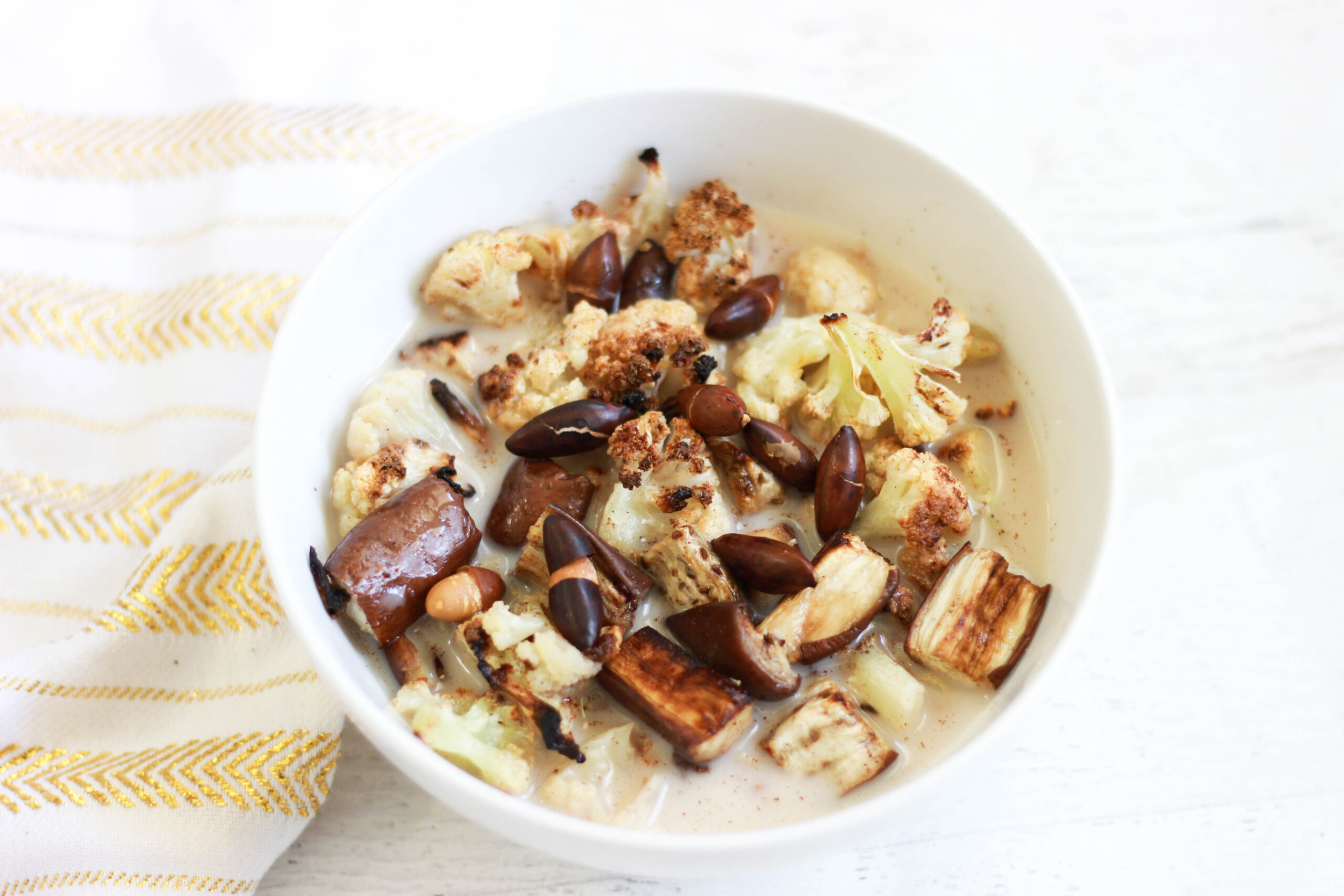
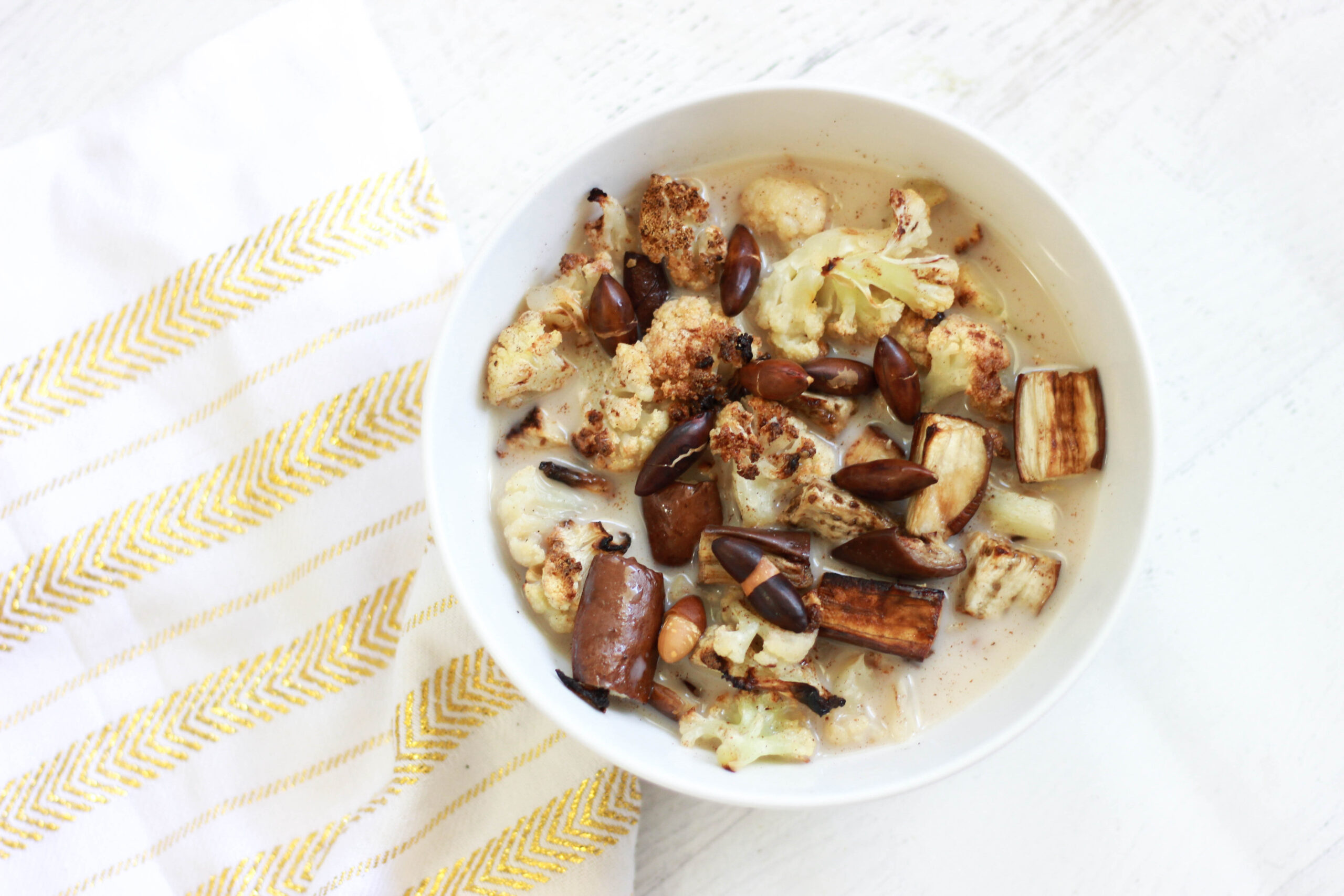
I’ve been doing something recently… and I wasn’t going to bother posting about it because I figured it was just a weird thing no one else would be into. I’m not sure if this even qualifies as a “recipe.” Then I told my friend about it, and she was really excited and wanted to try it. So I decided I might as well share it here. I’ve been eating “veggie cereal” for breakfast.
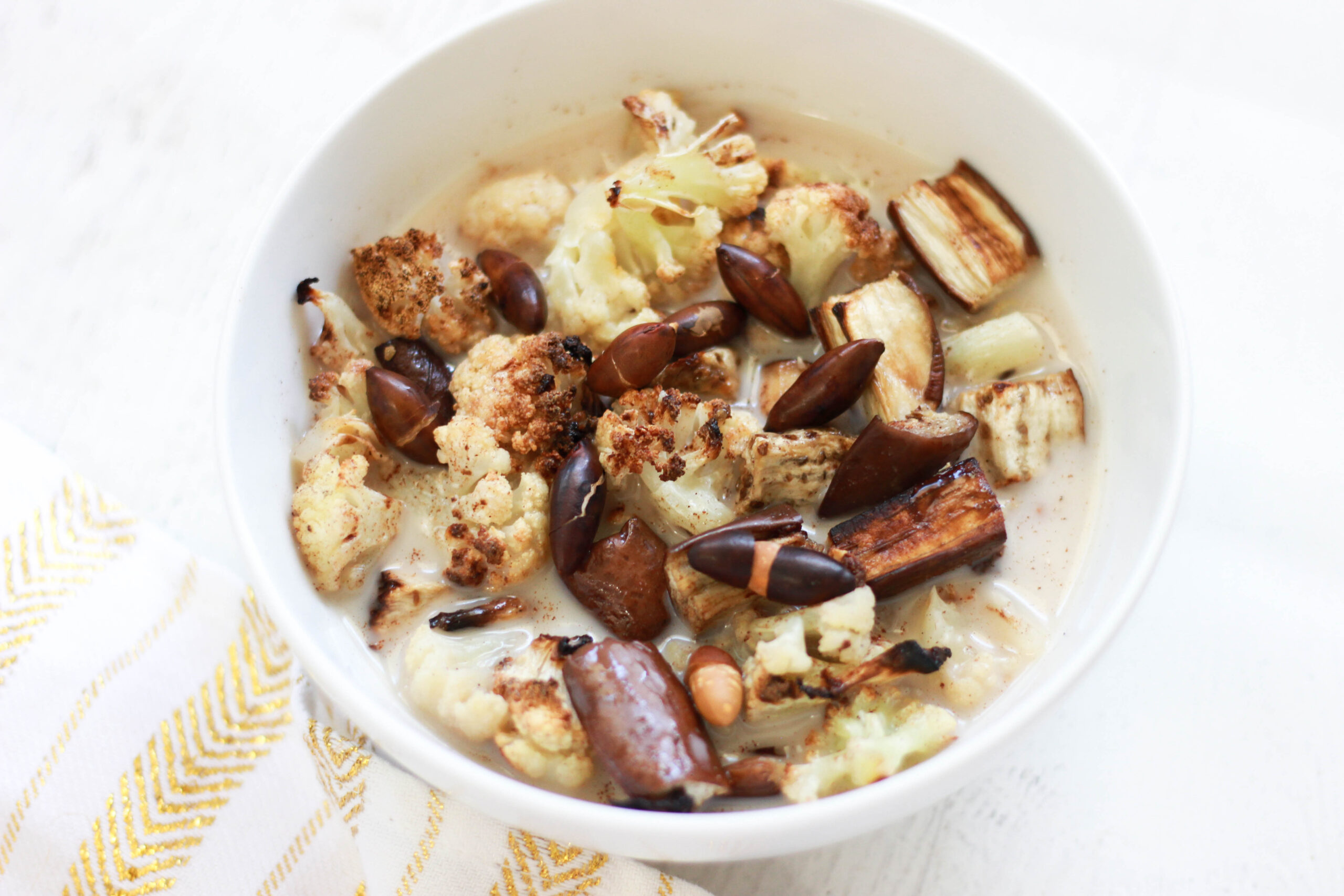
The last few weeks I’ve been feeling especially nostalgic. Watching old movies, going through old pictures, reading journal entries from 2009 – it’s been an interesting few weeks, to say the least. I find that when I want to move forward from where I am now, a lot of times I have to also work through more things from the past. Hence the trip down memory lane. Also, when I get stressed, I like to go back to things that always comforted me growing up. Anyways, diving into old memories made me start to crave a bunch of foods I used to eat regularly as a child. Interestingly enough, I was really craving a bowl of cereal.

I thought about going to the store and buying some “paleo cereal” just to satisfy my craving, but I realized it wouldn’t really hit the spot. I knew I’d just want some vegetables afterwards. My body does not get satisfied or ever feel full from food that doesn’t have real nutritional value, like a gluten-free cereal. You can ask my friends – I almost always eat vegetables after I go out for ice cream because I just “need something else.” Haha! I know… I’m odd. Not sure if this is a blessing or a curse. Also, the thought of a bowl of granola doesn’t appeal to me. I’ve never been a granola person, and a bowl of nuts didn’t sound like it would do me any digestive favors. Plus, most cereals are bland in flavor, in my opinion.
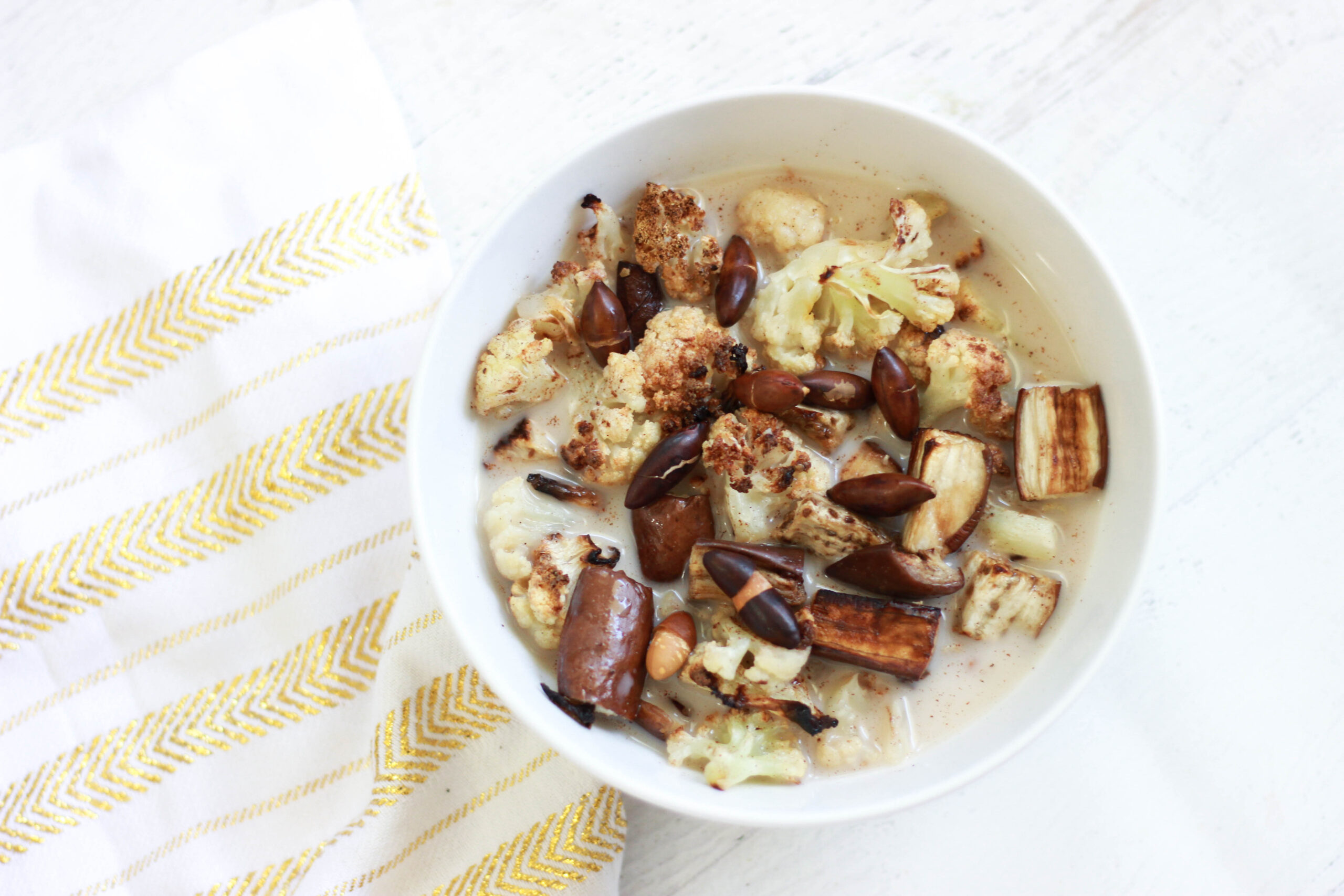
Plus, it wasn’t really the CEREAL itself that I wanted… it was a bowl of something with a slight “crunch” and cold milk. Besides that, I was really too lazy to go to the store. It’s been hot in L.A., and I just wanted to sit on my couch with a cold bowl of something “cereal-like” and watch a Disney movie. Not a huge ask, in my opinion. Immediately, I thought of cinnamon roasted vegetables – my favorite secret weapon for when I want something sweet that’s actually healthy. One of my favorite hacks. Certain cinnamon roasted veggies have a relatively crunchy texture when roasted well, particularly cauliflower and eggplant, and I wondered if I could use those as a “cereal” replacement.
I decided to try it out and mix in some nuts for an added crunch. It was delicious! I like this approach much more than filling a whole bowl with nuts (which I see many people doing), which I would argue is not ideal for anyone’s digestion. This way you still get the crunch of the nuts but that’s not all you’re eating. I used Barukas, which are my favorite nut/seed because they taste like peanuts with a slight undertone of coffee and cacao. (My discount code “wellness” will get you 15% off your first order!) I also added in some collagen peptides for added protein, and ended up topping it off with some almond butter too! I put it all in a bowl with a cup of almond milk, and it was EXACTLY what I wanted!
The cinnamon roasted eggplant and cauliflower were crispy enough to give a bit of crunch, and obviously the nuts even moreso. It was enough like cereal for my palette, and I quickly became obsessed. I also love how this is such an easy meal or snack to pull together quickly. You can roast the veggies ahead of time, and then just throw them in a bowl with milk and your other add-ins in the morning! I recommend making a full batch of cinnamon-roasted veggies, and then you can use however many you want in your “cereal bowl.”
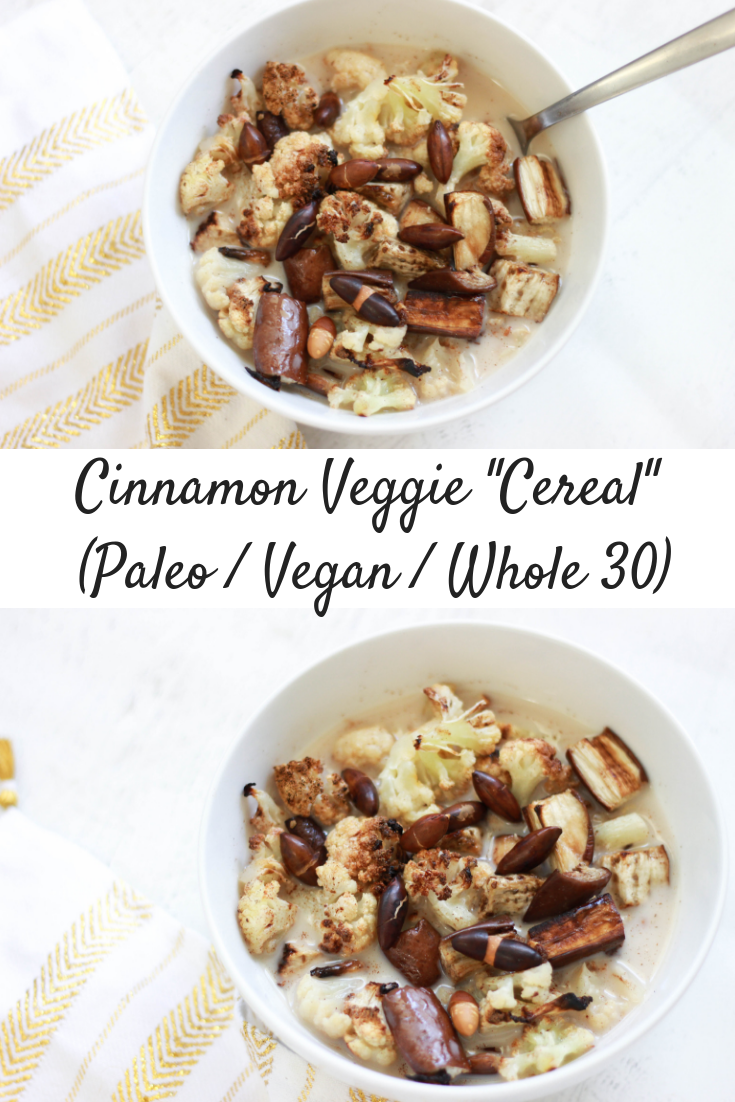
Once the veggies are prepped, it’s pretty much an instant meal, but you do have to prep the veggies ahead of time. You want to have plenty of time to roast them so that they get crispy on the outside for that crunch factor! I do not recommend steaming or sautéing the vegetables, because they’ll get too soft and won’t have the right texture. I’ve had this meal with the vegetables warm out of the oven, cooled to room temperature, and out of the fridge. I like them best cooled to room temperature or cold out of the fridge for true “cereal vibes.” When the veggies are warm, it doesn’t taste the same.
You can play around with different spices (pumpkin pie spice and apple pie spice have been in my rotation), different nut milks, different nuts and seeds, and different nut butters to mix-in. I tend to use almond or coconut milk, and Barukas or pecans as my nuts. I like dropping coconut butter in there too, because it hardens!
It might not be “real” cereal, but it hits the spot for me! This is a great paleo, vegan (if not using collagen peptides), Whole 30, keto, low-carb, candida-diet-friendly, gluten-free, dairy-free option for a breakfast or snack when you’re craving something like cereal but want something healthy. Don’t knock it until you try it! ;P
Cinnamon Veggie “Cereal” (Paleo / Vegan / Whole 30)
Ingredients:
- 1 head of cauliflower, chopped
- 1 eggplant, chopped into squares
- cinnamon, pumpkin pie spice, or apple pie spice – to taste, probably about 2-3 tsp
- Himalayan pink salt – to taste, probably 1-2 tsp
- coconut oil – enough to coat your vegetables
- 1 cup nut milk
- Optional mix-ins/toppings: handful of nuts (I used Barukas – code “wellness” gets you 15% off!), seeds, nut butter, coconut flakes, etc.
- Optional: Vital Proteins Collagen Peptides or vanilla protein powder
Instructions:
- First you’ll need to prep your veggies ahead of time. Preheat your oven to 415*F. Line two baking trays with parchment paper.
- Toss the chopped cauliflower and eggplant with coconut oil, cinnamon, and salt to taste. I like to season mine until they’re almost completely coated. Feel free to use other spices as well, like pumpkin pie spice, apple pie spice, nutmeg, or allspice.
- Spread the chopped cauliflower on one baking sheet, and the eggplant on the other. Roast for 30-40 minutes, or until the edges start to crisp. Flip the veggies halfway through cooking.
- The veggies should be a bit crispy with golden edges. You can leave them warm, allow them to cool to room temperature, or stick them in the fridge. I prefer them cooled in the fridge.
- Put however many veggies you want in a bowl (I use about 2 cups). Pour nut milk over top. Stir in collagen peptides or protein powder, if using them.
- Add in any mix-ins or toppings that you want. Nuts, seeds, nut butters, or coconut flakes are great options for an added crunch!
- Stir and enjoy!
What was your favorite childhood cereal?!
